
More on Language
Are you hearing a bunch of new terms? Try using ASHA as a search engine to learn more.
Receptive & Expressive Language
Receptive language is one’s ability to comprehend a verbal or non-verbal message. Expressive language is one’s ability to verbally or non-verbally communicate a message.
Components: Language delays or disorders can be demonstrated by difficulty answering simple questions, following directions, reduced verbal output, limited vocabulary usage, etc.
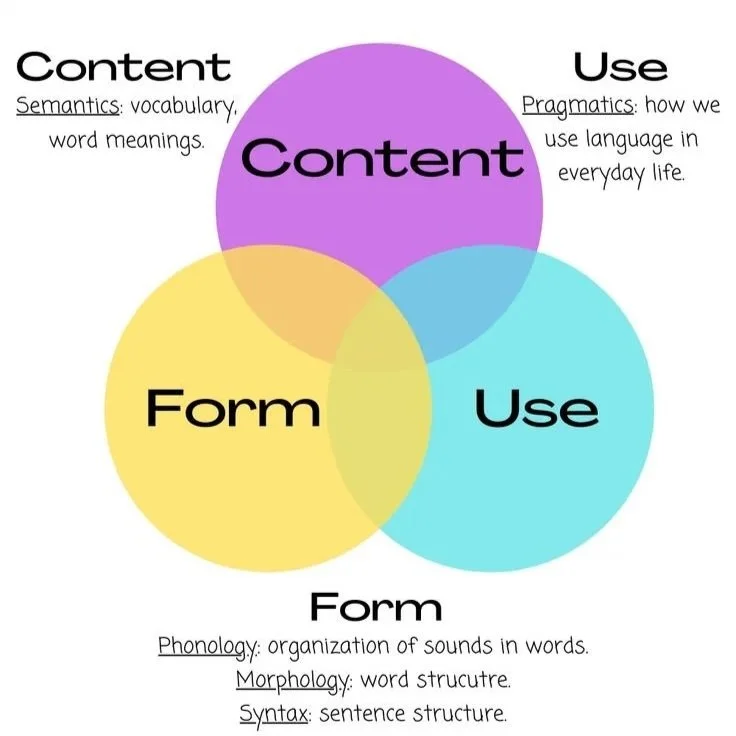
This Includes the five areas of language:
Vocabulary
Syntax (sentence structure)
Morphology (little parts such as pronouns and affixes)
Phonology (related to reading and spelling)
Pragmatics
social competencies including perspective taking
Synthesis of the 5 areas
Higher order thinking skills (such as making inferences)
Reading comprehension & writing (see other sections)
Speech
What You Might Notice
Substitutions: Replacing one sound with another (e.g., saying "wabbit" for "rabbit").
Omissions or Deletions: Leaving certain sounds or parts of words out entirely (e.g., saying "cu" instead of "cup" or "poon" for "spoon").
Distortions: Altering the sound, such as speaking with a lisp.
Reduced Intelligibility: Speech that is difficult to understand.
How We Help
Assessment: We evaluate hearing status, oral-motor structures and function to determine whether the challenge stems from an articulation, motor planning (apraxia), phonological disorder, or a combination.
Intervention: We guide students through a structured path of care—moving from discriminating sounds they hear to practicing targets in isolation, syllables, words, sentences, and eventually structured conversation.
Goal: To provide practical strategies that help individuals speak clearly and confidently in everyday environments, improving overall intelligibility and social-emotional well-being.
Oral & Written Language (Including Reading Comprehension)
Reading: Not only is reading decoding the text in front of you, but also understanding the meaning of the words and narrative as a whole.
Writing: Not only the spelling of words, but the organization of ideas in essays, narratives, and emails.
What You Might Notice
These skills vary depending on the individual's age.
Spoken Language Signs:
Difficulty understanding instructions, questions, or vocabulary.
Limited vocabulary size or trouble finding the right words during conversation.
Errors in grammar, sentence order, and tense (misusing or missing verb endings or pronouns, etc.).
Trouble engaging in conversation or telling a clear narrative story.
Written Language Signs:
Difficulty with phonological awareness (such as rhyming or blending sounds).
Challenges with word recognition while reading.
Trouble expressing ideas through writing.
How We Help
Assessment: Evaluating listening, speaking, reading, and writing skills, taking into account cultural and linguistic backgrounds (such as accents or dialects).
Intervention: Teaching language skills all together in addition to isolation, ensuring skills directly support everyday communication, academic, and social success.
Targets:
Spoken Language: Expanding vocabulary, increasing sentence length and complexity, and improving conversational and narrative abilities.
Written Language: Strengthening phonological awareness, reading comprehension, and writing skills including social competencies such as addressing audience, tone of voice, character motivation.
Cognitive-Communication
A cognitive-communication disorder involves an impairment of cognitive processes that affect communication, such as attention deficit disorders.
What You Might Notice
Attention: Easily distracted, difficulty maintaining focus during conversations, or trouble shifting attention between tasks.
Memory: Difficulty remembering new information, recalling recent events, or remembering steps in a routine.
Executive Function: Trouble planning, organizing tasks, or problem-solving.
Pragmatics: Missing social cues, interrupting others, wandering off-topic, or failing to understand abstract language (sarcasm, metaphor, etc).
Processing: Taking longer to process information or struggling to keep up with fast-paced conversations.
How We Help
Assessment: Diagnostic treatment of language skills might reveal that attention, memory, and executive functions are also impacting life and school experience.
Strategies:
Practice: Training to use memory aids (such as visualization or chunking) and external tools (such as planners, calendars, and digital reminders) to manage daily tasks.
Collaboration: Working with the individual and their support network (parents, school) to adapt to distractors, establish routines, and practice communication strategies for successful interactions.
Pragmatics: Social Competencies
What We Do: How you can help your child develop social skills
Be direct and objective
Focus on nonverbal communications
Facial Expression
Gestures
Tone and Voice
Use books and videos as learning tools
Watch a short video without sound and talk about what you each think is happening
Discuss motivation of choice and why person/character feels a certain way
Discuss character development
Check out SocialThinking